What Is a Powell Lens? Uniform Laser Line Generation Explained
Introduction
In many laser applications, generating a uniform laser line is much more difficult than it first appears.
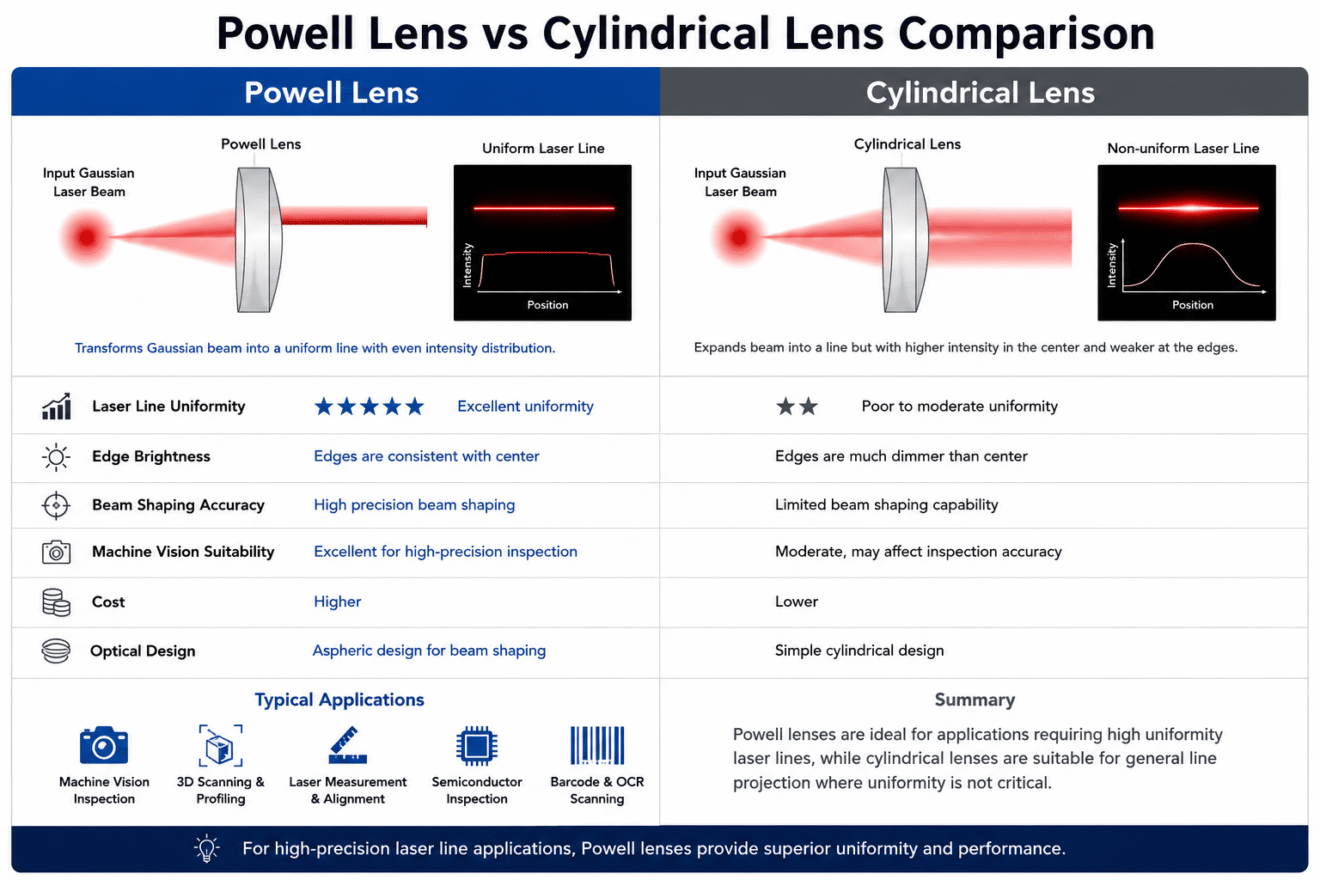
Standard cylindrical lenses can easily expand a laser beam into a line, but the intensity distribution is often uneven. The center of the laser line usually appears much brighter than the edges, which can negatively affect machine vision inspection, laser measurement accuracy, and image processing stability.
This is where Powell lenses become important.
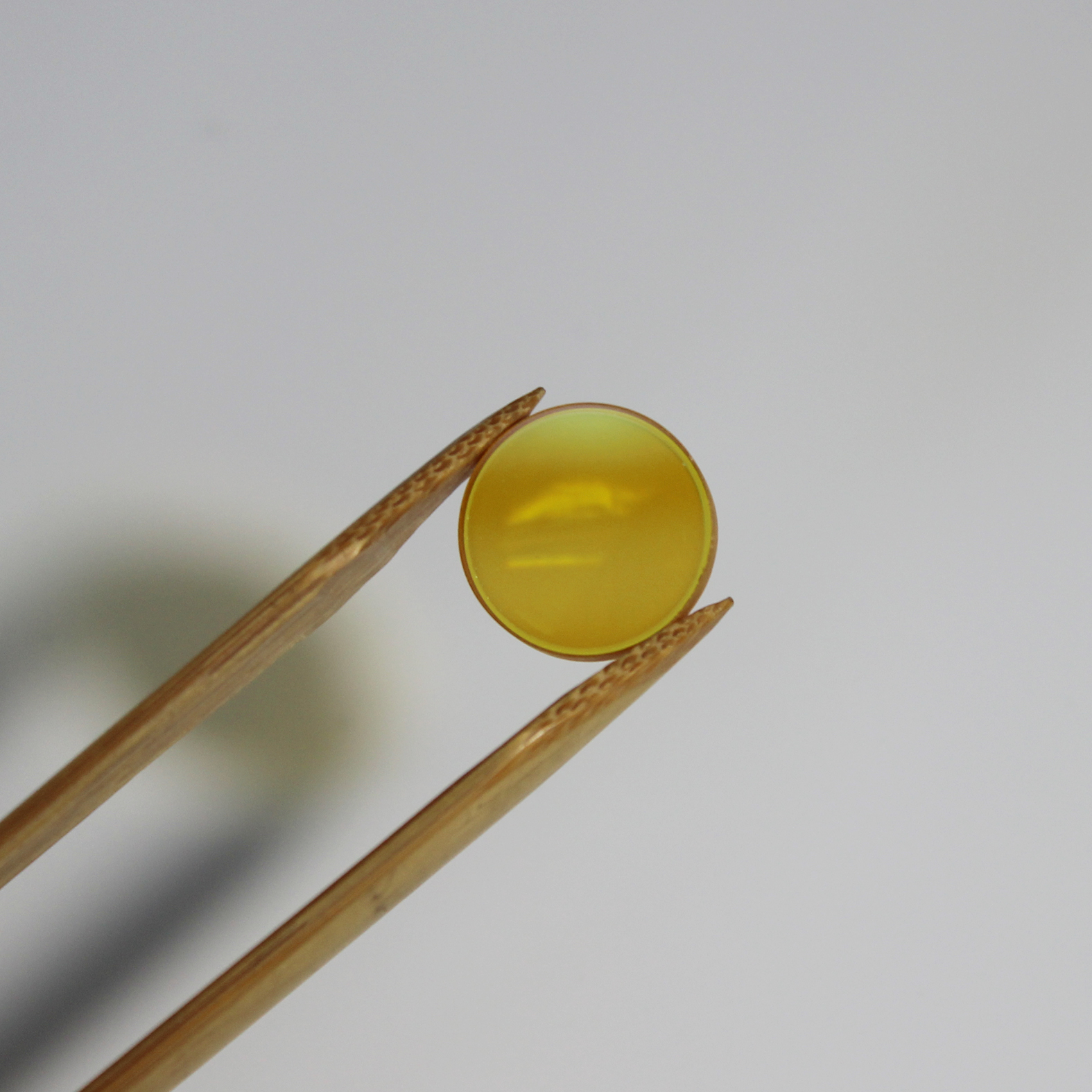
A Powell lens, sometimes referred to as a Powell prism or laser line generator lens, is specifically designed to create highly uniform laser lines for industrial and scientific applications.
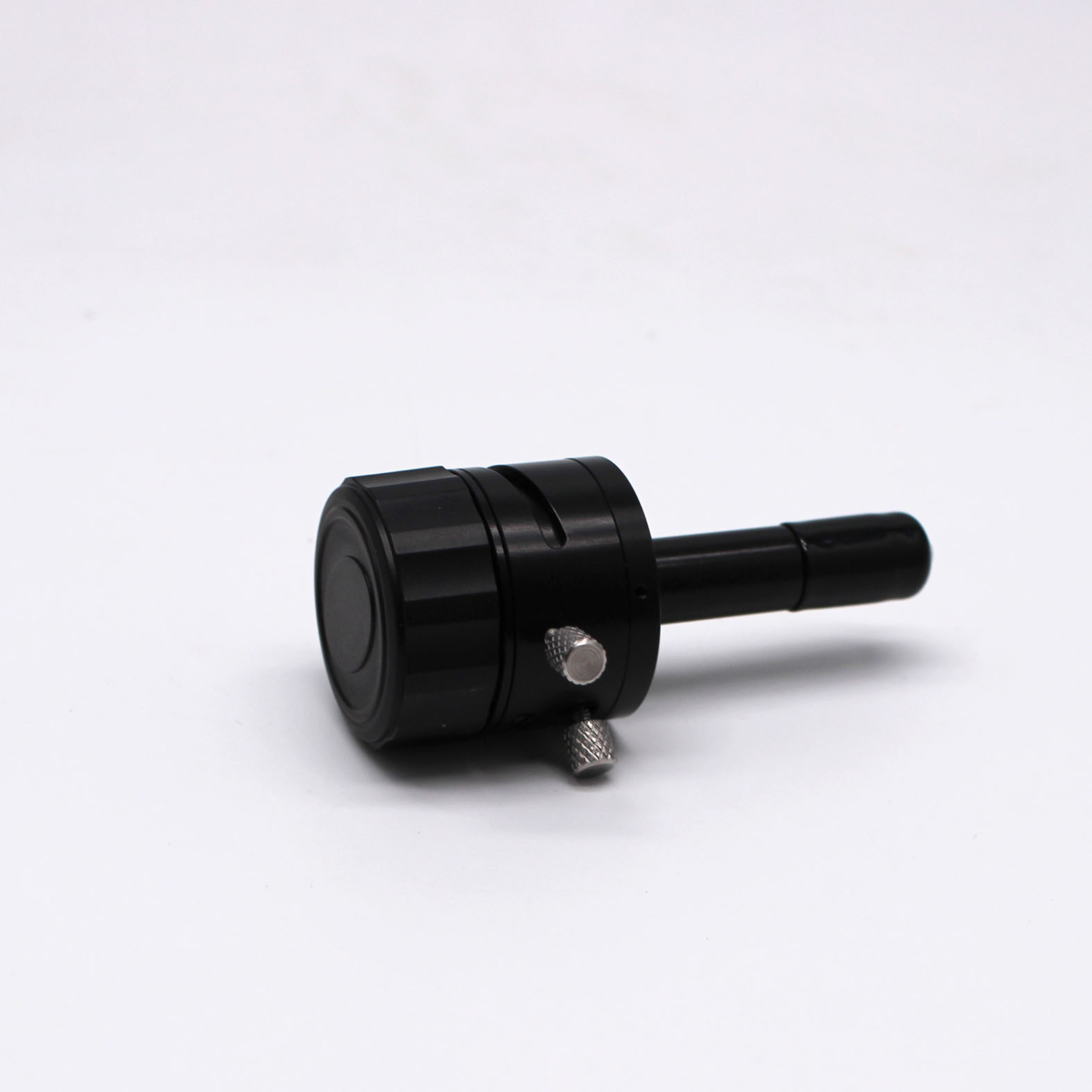
At VY Optics, we manufacture and customize Powell lenses for machine vision systems, laser alignment equipment, semiconductor inspection, and OEM laser modules.
How Does a Powell Lens Work?
Unlike a standard cylindrical lens, a Powell lens uses an aspheric optical profile to redistribute laser energy evenly along the projected line.
The lens transforms a Gaussian laser beam into a straight laser line with much more uniform intensity.
This optical design significantly improves:
- Laser line uniformity
- Edge brightness consistency
- Machine vision detection accuracy
- 3D scanning precision
- Laser triangulation stability
The center angle of the Powell lens contains complex curvature compensation that helps balance the energy distribution from the laser source.
Because of this special beam shaping capability, Powell lenses are widely used in precision laser optics systems.
Powell Lens vs Cylindrical Lens
One of the most common engineering questions is:
What is the difference between a Powell lens and a cylindrical lens?
Although both optics can generate laser lines, their performance is very different.
| Feature | Powell Lens | Cylindrical Lens |
|---|---|---|
| Laser line uniformity | Excellent | Poor to moderate |
| Edge brightness | Consistent | Weak |
| Beam shaping accuracy | High | Limited |
| Machine vision suitability | Excellent | Moderate |
| Cost | Higher | Lower |
| Optical design | Aspheric | Simple cylindrical |
In many machine vision projects, engineers initially select cylindrical lenses because of their lower cost. However, uneven laser intensity often becomes a major issue during inspection and image analysis.
For applications requiring accurate laser measurement or stable line illumination, Powell lenses are usually the preferred solution.
Why Laser Line Uniformity Matters
Uniform laser illumination is critical in modern optical systems.
If the laser line contains hot spots or intensity drop-off, it may cause:
- Unstable edge detection
- Inaccurate dimensional measurement
- Reduced scanning precision
- Poor image processing performance
- Calibration instability
This is especially important in:
- 3D laser scanning
- Laser triangulation
- Semiconductor inspection
- Machine vision systems
- Industrial automation
- Medical laser systems
A properly designed Powell lens can significantly improve system reliability and measurement repeatability.
Common Applications of Powell Lenses
Powell lenses are widely used in industrial and scientific laser systems.
Typical applications include:
Machine Vision Inspection
Uniform laser lines improve edge detection and dimensional measurement accuracy.
3D Laser Scanning
Powell lenses help generate stable laser planes for high-precision scanning systems.
Laser Alignment Systems
Laser alignment tools require highly visible and consistent laser lines.
Semiconductor Equipment
Laser beam shaping optics are commonly used in wafer inspection and positioning systems.
Medical Laser Systems
Medical imaging and positioning equipment often require precise laser line generation.
Barcode and OCR Systems
Uniform laser illumination improves reading consistency and reduces scanning errors.
How to Choose the Right Powell Lens
Selecting the correct Powell lens depends on several engineering parameters.
Important factors include:
- Laser wavelength
- Fan angle
- Input beam diameter
- Working distance
- Laser power
- Required line uniformity
- Application environment
Common fan angles include:
- 5°
- 10°
- 30°
- 45°
- 60°
- 90°
- 110°
Different applications require different beam shaping characteristics.
For example:
- Narrow fan angles are often used in long-distance laser projection.
- Wide fan angles are commonly used in machine vision and scanning systems.
Custom Powell Lens Manufacturing
At VY Optics, we provide custom Powell lens manufacturing services for OEM and industrial applications.
Customization options include:
- Custom fan angles
- Different laser wavelengths
- AR coatings
- Optical glass materials
- Beam shaping optimization
- OEM laser module integration
Our engineering team supports both prototype development and volume production for laser optics projects.
Why Choose VY Optics?
As a professional optical manufacturer, VY Optics specializes in precision optical components and optical system integration.
Our capabilities include:
- Precision optical manufacturing
- Optical design support
- Custom laser optics
- Optical assembly and alignment
- Small-batch prototyping
- OEM optical solutions
We support customers worldwide in machine vision, laser systems, semiconductor equipment, and scientific imaging industries.
Request a Custom Powell Lens Quote
Looking for a custom Powell lens or laser beam shaping solution?
Our engineering team can help optimize your laser line generation system for machine vision, 3D scanning, laser alignment, and industrial automation applications.
Contact VY Optics for technical support, prototype evaluation, or OEM production inquiries.