Introduction
In many machine vision projects, image clarity is not the main problem—distortion is.
We’ve worked on several inspection systems where the image looked sharp, but measurements were still inaccurate. Edges didn’t align properly, and objects appeared slightly stretched or compressed depending on their position.
In most of these cases, the issue wasn’t the camera or software.
It was lens distortion.
We are going to share some practical ways to reduce distortion in machine vision applications, based on what we’ve seen in real projects.
What Causes Distortion in Machine Vision Systems?
Distortion is mainly introduced by the optical system, especially the lens design.
The most common types include:
- barrel distortion (image bulges outward)
- pincushion distortion (image pulls inward)
- perspective distortion (size changes with distance)
In machine vision, even small distortion can affect:
- dimensional measurement
- edge detection
- alignment accuracy
For inspection tasks, this quickly becomes a problem.
When Distortion Becomes a Real Issue
Not every application requires extremely low distortion.
But it becomes critical when:
- you need accurate measurement
- objects must maintain consistent size
- the system compares parts across positions
- tolerance requirements are tight
We’ve seen customers initially ignore distortion, only to find later that measurement errors were inconsistent and difficult to correct.
Choosing the Right Lens Type
One of the most effective ways to reduce distortion is simply choosing the right lens.
Standard Lenses
Standard lenses are fine for:
- general imaging
- defect detection
- non-measurement tasks
But they usually introduce some level of distortion.
Telecentric Lenses
Telecentric lenses are designed to minimize perspective distortion.
They help ensure:
- consistent magnification
- better measurement accuracy
- reduced edge error
For high-precision inspection, they are often the better choice.
We’ve discussed this in more detail in our article on telecentric vs standard lenses.
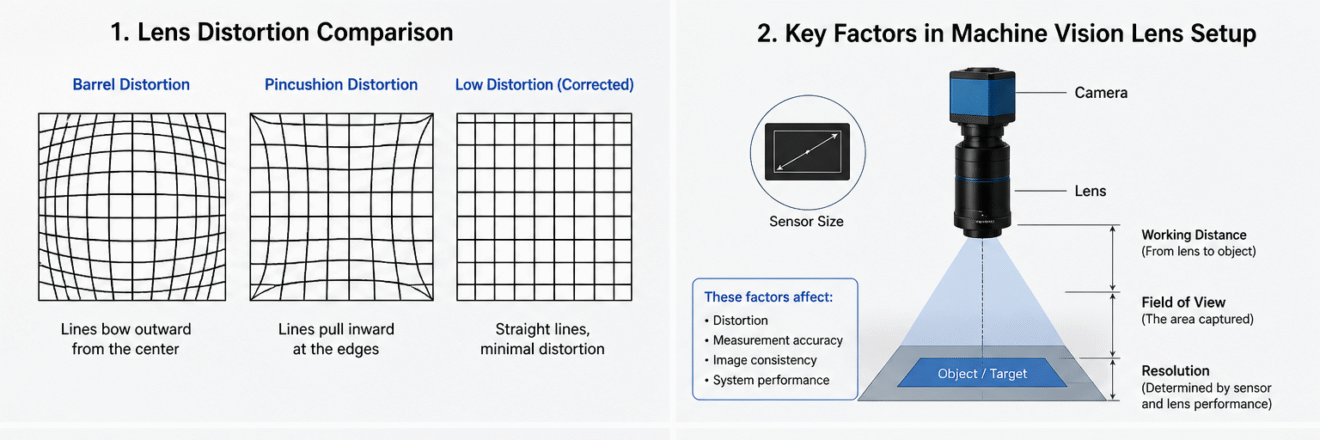 Key factors in machine vision lens setup affecting distortion and measurement accuracy.
Pay Attention to Working Distance and Field of View
Even with a good lens, distortion can increase if the system setup is not appropriate.
Two important factors:
- working distance
- field of view
If the lens is used outside its optimal range, distortion tends to increase.
In some projects, simply adjusting the working distance significantly improved measurement stability.
Sensor Matching Matters More Than Expected
Another common issue is mismatch between lens and sensor.
For example:
- using a large sensor with a lens not designed for it
- pushing the lens to the edge of its image circle
This often increases distortion at the image edges.
Choosing a well-matched lens-sensor combination helps maintain consistent image quality.
Assembly and Alignment Still Matter
This is something often overlooked.
Even with a well-designed lens, distortion can increase due to:
- decentration
- tilt
- assembly errors
We’ve seen systems where distortion issues were not caused by design, but by assembly.
In precision applications, alignment accuracy is just as important as optical design.
Software Correction: Useful, But Not a Solution
Distortion can also be corrected through software calibration.
However:
- it adds processing complexity
- it cannot fully recover lost accuracy
- it depends on stable system conditions
In our experience, it’s better to reduce distortion optically first, then fine-tune with software if needed.
Final Thoughts
Reducing distortion in machine vision is not about a single factor.
It usually comes down to a combination of:
- proper lens selection
- correct system setup
- sensor matching
- precise assembly
In many cases, the biggest improvements come from simple adjustments rather than complex redesigns.

Need Help Optimizing Your Imaging System?
If you are working on a machine vision or inspection project and struggling with distortion or measurement accuracy, feel free to contact us.
We support custom optical design, manufacturing, and precision assembly for industrial imaging systems—and we’re always happy to discuss practical solutions.