Introduction
In the past few years, we have been involved in several underwater imaging projects, including some for deep-sea applications.
One thing we noticed is that designing an optical lens for underwater use is quite different from designing a normal lens in air. Some problems don’t show up in simulation, but appear later in real systems.
In this article, I share some practical experience on how to design optical lenses for underwater imaging systems.

Start from the Real Environment, Not Ideal Conditions
In many optical designs, we usually start from ideal conditions:
- perfect alignment
- stable structure
- no external stress
But underwater systems are very different.
You need to think about:
- water pressure
- temperature
- long-term sealing
- real working distance in water
If these are not considered early, the design may look good, but will not work well in reality.
The Optical Path Changes in Water
This is something many people underestimate.
When light travels in water instead of air, the refractive index changes. This will affect:
- focal length
- field of view
- distortion behavior
Also, if there is a protective window or dome, things become more complicated.
In some projects, we found that the main image issue was not from the lens itself, but from the interface between water and the optical window.
Distortion Control Is More Difficult Than Expected
In underwater imaging, distortion is not always easy to control.
Especially when:
- using wide-angle lenses
- imaging through flat or dome windows
- working at different distances
If distortion is not handled properly, it will affect:
- image accuracy
- object shape
- measurement results
In some cases, correction in software is not enough.
Mechanical Design Affects Optical Performance
At first, many people think mechanical structure is just for holding the lens.
But in underwater systems, it is much more important.
High pressure can cause:
- small deformation
- stress on optical components
- shift in alignment
Even very small changes can reduce image quality.
So mechanical design and optical design should be considered together.
Alignment and Assembly Become More Critical
From our experience, this is one of the key points.
In underwater lenses, especially multi-element systems, small errors in:
- centration
- tilt
- spacing
can lead to visible image degradation.
Also, once the system is sealed, it is almost impossible to adjust.
So the design should already consider:
- how to assemble
- how to control alignment
- how to keep stability over time
Material Selection Is Not Only About Optics
Choosing materials is not only about transmission.
You also need to think about:
- pressure resistance
- long-term stability
- compatibility with sealing
- mechanical strength
Sometimes a material with good optical performance is not the best choice for underwater use.
Design for Manufacturing and Assembly
One lesson we learned from real projects:
A design that is too “perfect” in theory may be difficult to manufacture.
For example:
- tolerances too tight
- structure difficult to assemble
- alignment too sensitive
In these cases, even if one sample works, batch production becomes a problem.
So it is better to balance:
- performance
- manufacturability
- assembly feasibility
from the beginning.
Final Thoughts
Designing optical lenses for underwater imaging is not just about optics.
It is more like a combination of:
- optical design
- mechanical design
- assembly and alignment
- real environment understanding
In our experience, many problems come from the gap between design and real conditions.
If this gap is considered early, a lot of issues can be avoided later.
Work With Us
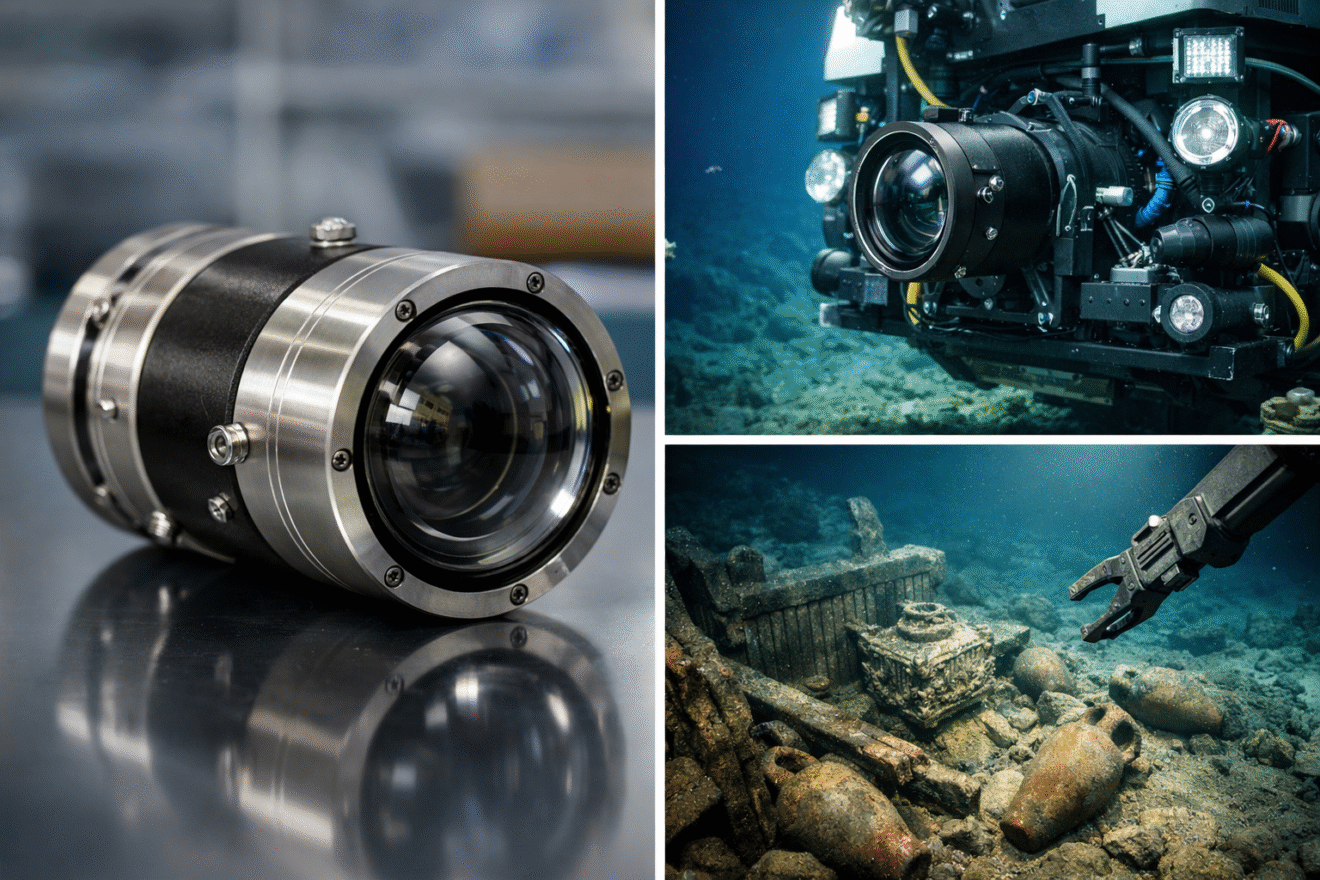
We have worked on different custom optical systems, including:
- underwater imaging optics
- infrared lenses
- industrial optical systems
- precision optical assembly and alignment
If you are working on a similar project, or still in early design stage,we are always open to exchange ideas and see what is possible.