Introduction
In machine vision projects, we often hear a similar question from customers:
“Do we really need a telecentric lens, or will a standard lens be enough?”
At first glance, both lenses can produce clear images.
But once the application involves measurement, dimensional inspection, or high consistency requirements, the difference becomes much more obvious.
In several projects we’ve worked on, customers initially selected standard lenses to reduce cost—but later realized the imaging results were unstable for inspection tasks.
This article shares some practical differences between telecentric lenses and standard lenses, and when each option makes sense.
Why Standard Lenses Are Common
Standard lenses are widely used because they are:
- more affordable
- easier to source
- available in many focal lengths
- suitable for general imaging applications
For applications like:
- basic visual monitoring
- object recognition
- barcode reading
a standard lens is often enough.
For many simple machine vision projects, using a telecentric lens may be unnecessary.
Where Standard Lenses Create Problems
Problems usually appear when customers need:
- dimensional measurement
- edge detection
- precision inspection
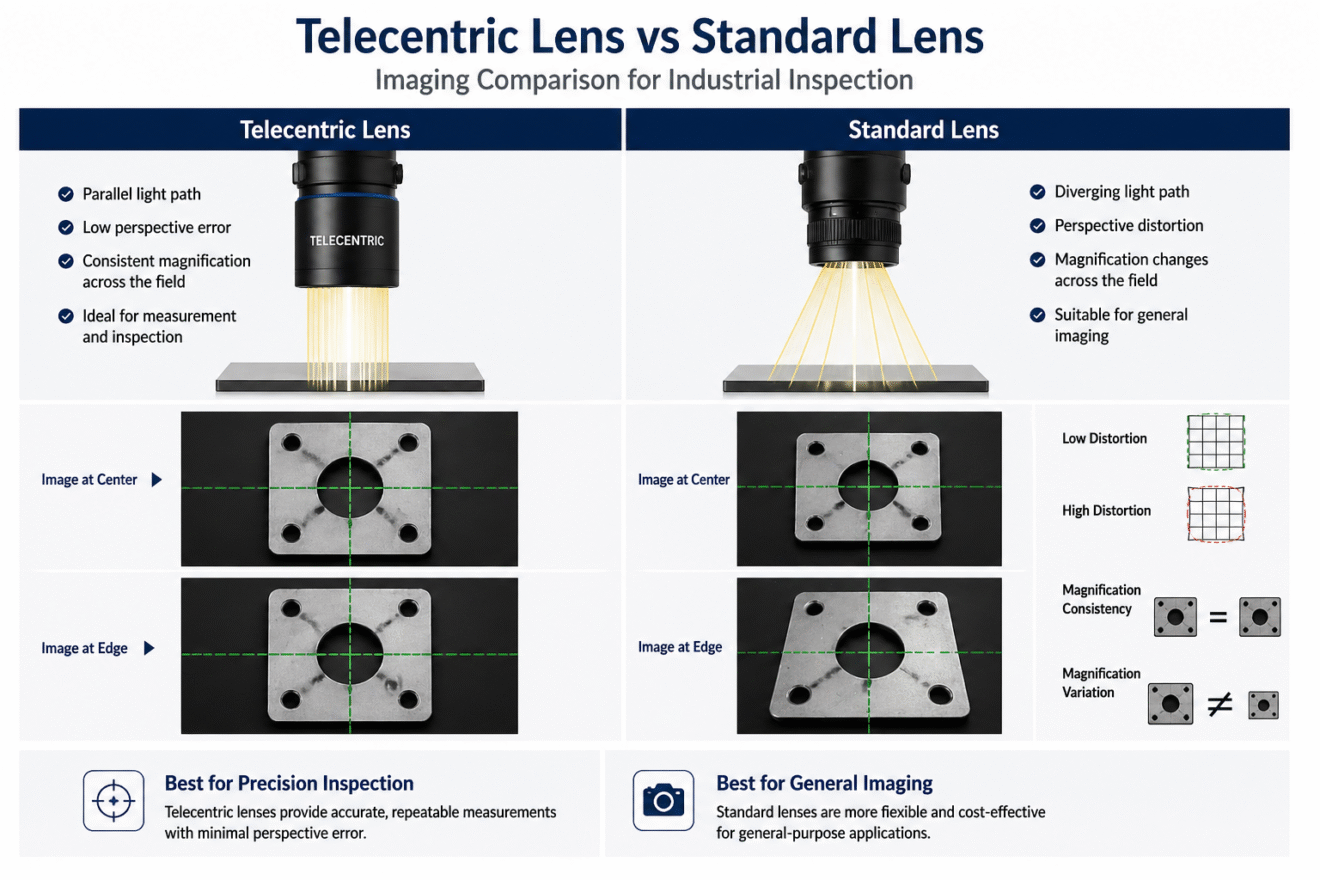
With standard lenses, objects may appear slightly different in size depending on position.
This happens because of perspective distortion.
In real inspection environments, this can create measurement errors.
We’ve seen situations where customers thought their software had problems, but the real issue was lens selection.
Why Telecentric Lenses Perform Better for Precision Inspection
Telecentric lenses are designed to minimize perspective error.
This means:
- object size remains more consistent
- edge detection becomes easier
- measurement accuracy improves
They are commonly used in:
- semiconductor inspection
- precision manufacturing
- electronic component measurement
- medical device inspection
But Telecentric Lenses Are Not Always the Best Choice
This is something many articles don’t mention.
Telecentric lenses also have limitations:
- higher cost
- larger physical size
- shorter working distance constraints in some designs
For some applications, a properly designed standard lens may be a more practical choice.
The right answer depends on the inspection task.
Questions We Usually Ask Customers
Before recommending a lens solution, we usually ask:
- Are you measuring dimensions or only detecting defects?
- What accuracy is required?
- What is the working distance?
- What sensor are you using?
- Is installation space limited?
These questions often determine whether telecentric optics are necessary.
Lens Performance Is Not Just About Optical Design
One thing customers often overlook:
Even the right lens design can perform poorly if manufacturing and assembly are not controlled well.
We’ve seen imaging issues caused by:
- alignment error
- assembly tolerance issues
- inconsistent batch quality
This is why lens design and manufacturing capability matter equally.
Final Thoughts
There is no universal “better” lens.
Telecentric lenses are excellent for high-precision measurement.
Standard lenses are often better for cost-sensitive or general imaging tasks.
The best choice depends on your actual application—not just specifications on paper.
Need Help Choosing the Right Lens?
If you’re working on a machine vision or industrial inspection project and are unsure which lens type makes sense, feel free to reach out.
We work on custom optical design, manufacturing, and precision assembly for industrial imaging applications—and we’re always happy to discuss practical solutions.