Low-Distortion Lens Selection Guide for AOI and Industrial Inspection
Introduction
When customers choose a lens for AOI or industrial inspection equipment, they often start with focal length, working distance, and camera resolution.
These parameters are important, but they do not fully answer one key question:
Can the lens keep the image geometry stable enough for reliable inspection?
In many AOI systems, the image may look clear, but the measurement result is still unstable. A line may appear slightly curved near the edge. A hole may measure differently in different areas of the image. A connector pin may look shifted even when the part itself is correct.
In these situations, lens distortion may be one of the reasons.
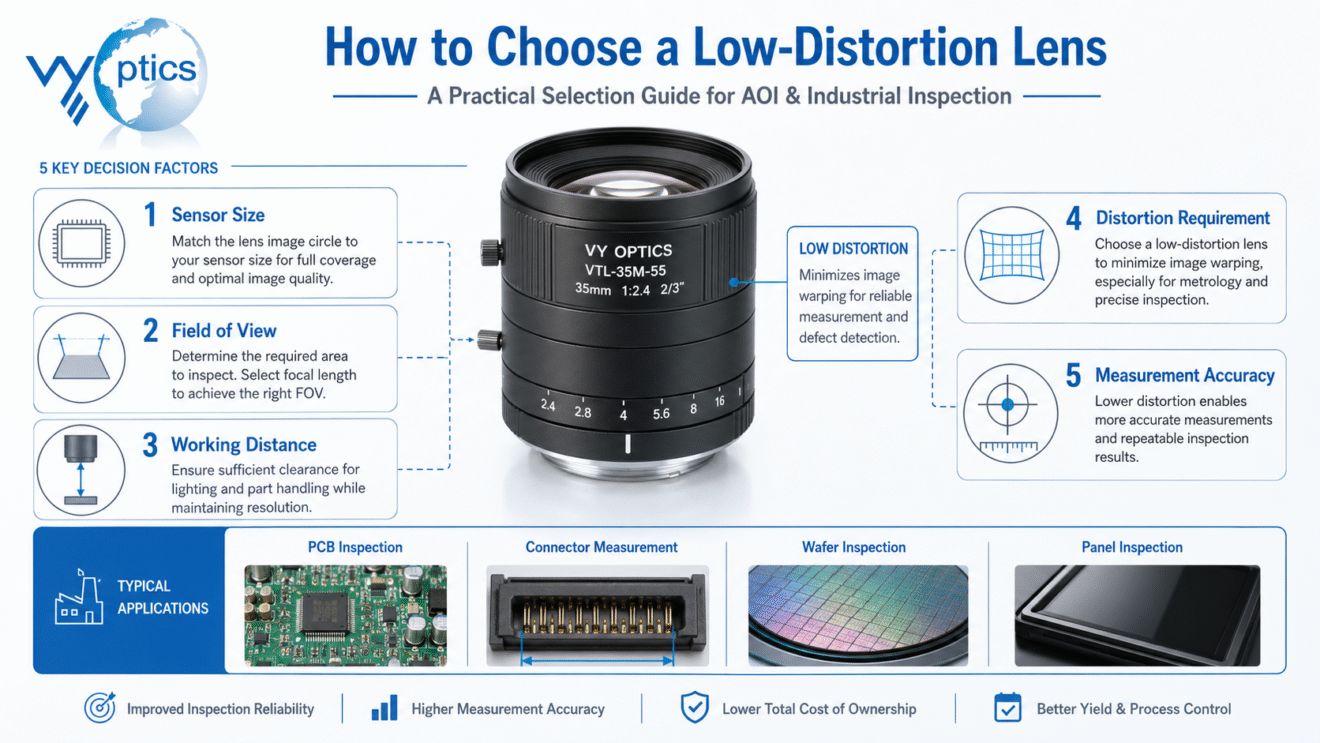
This article is not only about what distortion is. Instead, it focuses on how to choose a low-distortion lens for AOI, PCB inspection, connector measurement, wafer inspection, display panel inspection, and precision industrial imaging.
As a custom optical lens manufacturer, VY Optics supports low-distortion lens design, flat-field machine vision lenses, telecentric lenses, optical manufacturing, precision assembly, and opto-mechanical integration for industrial inspection applications.
Why Low Distortion Matters in AOI Inspection
AOI systems do not only need to see defects. In many cases, they also need to judge position, size, edge distance, hole diameter, alignment, or spacing.
If the lens has obvious distortion, the image geometry will not fully match the real object geometry. As a result, the software may calculate a value from an image that is already slightly deformed.
This can create problems such as:
- unstable measurement results
- different values between center and edge
- false rejects
- missed defects
- repeated calibration
- lower confidence in inspection data
For visual inspection, a small amount of distortion may not always matter. However, for AOI measurement and precision industrial inspection, low distortion can directly affect whether the system is reliable in production.
That is why low-distortion performance should be considered early, not only after the camera and lighting have already been selected.
When Do You Need a Low-Distortion Lens?
Not every inspection project needs a very strict low-distortion lens.
If the system only needs to find obvious scratches, stains, or large defects in the center of the image, a standard machine vision lens may be enough.
However, a low-distortion lens becomes more important when the system needs to:
- measure part size or position
- inspect features near the edge of the image
- compare measurement values across the whole field
- inspect a large field of view
- use a larger sensor
- reduce calibration difficulty
- improve repeatability in batch production
- measure small holes, pins, pads, or edges
For example, if a connector pin appears near the image edge, distortion may make the pin position look slightly different from its real position. If the system is used for measurement, this small difference can affect the final judgment.
In practical AOI work, the question is not simply whether the image looks clear. The better question is whether the image can support stable inspection and measurement.
Low-Distortion Lens for PCB, Connector, Wafer and Panel Inspection
Different applications have different requirements for distortion control.
For PCB inspection, the system may need to check pads, traces, holes, solder areas, and component positions. If distortion is not well controlled, measurement or alignment results may vary across the board.
For connector inspection, pin spacing, pin height, alignment, and coplanarity may be important. In this case, distortion can affect edge and position judgment.
For wafer inspection, mark position, small patterns, surface features, and local defects may require stable imaging across the field.
For display panel inspection, the field of view can be large, and edge consistency becomes more important. Distortion may affect alignment, pattern inspection, or defect location.
For precision component inspection, the part may have tight dimensional requirements. If the same part gives different values at different image positions, the inspection system will be difficult to trust.
So the lens should be selected according to the real inspection target, not only according to focal length or camera resolution.
Sensor Size, Field of View and Distortion Control
Sensor size has a strong influence on lens selection.
A small sensor mainly uses the central area of the lens image field. Since the center is usually easier to optimize, distortion may not look very obvious.
A larger sensor uses more of the lens field, including areas closer to the edge. This means distortion, edge softness, and illumination fall-off may become more visible.
This is why a lens that works well on a 2/3” sensor may not perform well enough on a 1” or 4/3” sensor.
Field of view also matters.
A wider field of view usually makes distortion harder to control. If the system needs to inspect a large area and measure features across the full image, the lens design becomes more demanding.
Before choosing a low-distortion lens, customers should confirm:
- camera sensor size
- pixel size
- required field of view
- working distance
- smallest feature size
- acceptable distortion level
- required measurement accuracy
- edge image quality requirement
A larger sensor or wider field of view can be useful, but only when the lens supports it properly.
Low-Distortion Lens, Flat-Field Lens or Telecentric Lens?
Customers sometimes ask which lens type is better: low-distortion, flat-field, or telecentric.
These terms are related, but they do not mean the same thing.
A low-distortion lens helps keep image geometry more accurate. It is important for measurement and position judgment.
A flat-field lens helps maintain clearer image quality from the center to the edge. It is useful when defects may appear anywhere in the field of view.
A telecentric lens helps keep magnification more stable when object height or position changes within the designed range. It is often used for high-accuracy dimensional measurement.
In some AOI systems, one of these characteristics is enough.
In other systems, the lens may need more than one of them.
For example:
- surface defect inspection may need flat-field performance
- dimensional measurement may need low distortion
- height variation may require telecentricity
- high-accuracy AOI may need flat-field, low-distortion, and telecentric design together
The right choice depends on the inspection target, not only the lens name.
Practical Lens Selection Checklist
Before choosing a low-distortion lens, it is useful to prepare the following information.
Camera and sensor
- sensor size
- pixel size
- resolution
- camera mount
Optical requirement
- field of view
- working distance
- wavelength or light source
- required depth of field
- smallest defect or feature size
Measurement requirement
- acceptable distortion
- required measurement accuracy
- whether the system measures center only or full field
- whether edge measurement is important
Object condition
- flat or three-dimensional object
- reflective or matte surface
- height variation
- moving or fixed object
Mechanical requirement
- available installation space
- mount interface
- focusing method
- need for locking structure
- vibration or temperature conditions
These details help determine whether a standard lens can be used or whether a customized low-distortion lens is necessary.
In many projects, early clarification saves much more time than repeated adjustment after installation.
When Is a Standard Lens Enough?
A standard machine vision lens may be enough when the inspection task is relatively simple.
For example, the project may not require strict measurement accuracy, or the inspected object may only appear in the central area of the image.
A standard lens may be suitable when:
- the sensor size is small
- the field of view is not too wide
- the inspected feature is relatively large
- edge measurement is not important
- distortion tolerance is not strict
- the system mainly performs simple defect detection
In these cases, using a standard lens can reduce cost and shorten delivery time.
However, customers should still check whether the lens supports the sensor size and field of view properly. A standard lens is not a problem by itself. The problem appears when the lens is forced into an application it was not designed for.
When Custom Low-Distortion Lens Design Is Necessary
Custom low-distortion lens design becomes more useful when the system has special or strict requirements.
For example, the project may need:
- larger sensor coverage
- lower distortion across the full field
- better edge consistency
- special working distance
- compact mechanical structure
- customized wavelength range
- stable performance for batch inspection
- special mount or flange requirement
- integration with existing AOI equipment
Sometimes the customer already has the camera, lighting, and machine structure. In that case, the lens must fit into a fixed system.
Other times, the optical design can start together with the system design. This usually gives more room for optimization.
At VY Optics, we usually prefer to understand the actual system first. After that, we can judge whether the project needs a standard lens, a modified lens, or a fully customized optical design.
VY Optics Support for AOI and Industrial Inspection Lenses
VY Optics provides custom optical lens solutions for AOI, machine vision, industrial inspection, and precision measurement applications.
Depending on the project, we can support:
- low-distortion lens design
- flat-field machine vision lens design
- telecentric lens design
- optical component manufacturing
- precision lens assembly and alignment
- customized wavelength coatings
- mechanical structure design
- complete lens module development
- opto-mechanical integration
Some customers only need optical components or a lens group. Others need a complete optical module that can be installed into their inspection equipment.
For measurement applications, the final result depends on more than the optical design file.
Manufacturing accuracy, lens centration, mechanical tolerances, coating, assembly, and alignment all affect the final image quality and measurement stability.
This is why we pay attention to the full process from optical requirement to final assembly.
What Information Should You Send for a Quotation?
To evaluate a low-distortion lens project, the following information is usually helpful:
- camera model or sensor size
- pixel size and resolution
- required field of view
- working distance
- wavelength or light source
- smallest defect or feature size
- measurement accuracy requirement
- acceptable distortion level
- object size and surface condition
- object height variation
- illumination method
- mount or flange requirement
- available mechanical space
- expected quantity or project stage
Even if some parameters are not fixed yet, it is still useful to start a technical discussion.
Sometimes customers come to us with only a rough idea. After reviewing the application, we can help clarify which parameters are important and which direction may be more practical.
Final Thoughts
Choosing a low-distortion lens is not only about finding a lens with a good number on a datasheet.
For AOI and industrial inspection, the lens must match the camera, field of view, working distance, measurement task, object condition, and mechanical structure.
A clear image is useful, but a geometrically stable image is more important for measurement.
If your system has unstable measurement results, different values between center and edge, repeated calibration problems, or difficulty matching a larger sensor, the lens may be worth reviewing.
In many machine vision projects, choosing the right lens early can reduce debugging time and improve long-term inspection stability.
Need Help Choosing a Low-Distortion Lens?
If you are selecting a lens for AOI equipment, PCB inspection, connector measurement, wafer inspection, display panel inspection, or precision industrial imaging, VY Optics can help evaluate the optical requirements.
Please send us your sensor size, field of view, working distance, wavelength, smallest feature size, distortion requirement, and measurement target.
We can discuss whether a standard lens, low-distortion lens, flat-field lens, telecentric lens, or custom optical design is more suitable for your project.