Introduction
One thing we’ve noticed in machine vision projects over the past few years:
Higher resolution cameras do not always produce better images.
In fact, some systems become even harder to optimize after upgrading the sensor.
Customers sometimes expect that moving from 5MP to 12MP or even 20MP will automatically improve inspection performance. But after the upgrade, they still run into problems like:
- unclear edges
- unstable measurement results
- inconsistent image quality
At that point, many people start questioning the camera itself.
But in real projects, the camera is often only one part of the story.
Image quality depends on how the entire optical system works together.
In many projects, lens selection itself becomes one of the biggest factors affecting final imaging performance.
More Pixels Don’t Automatically Improve Image Quality
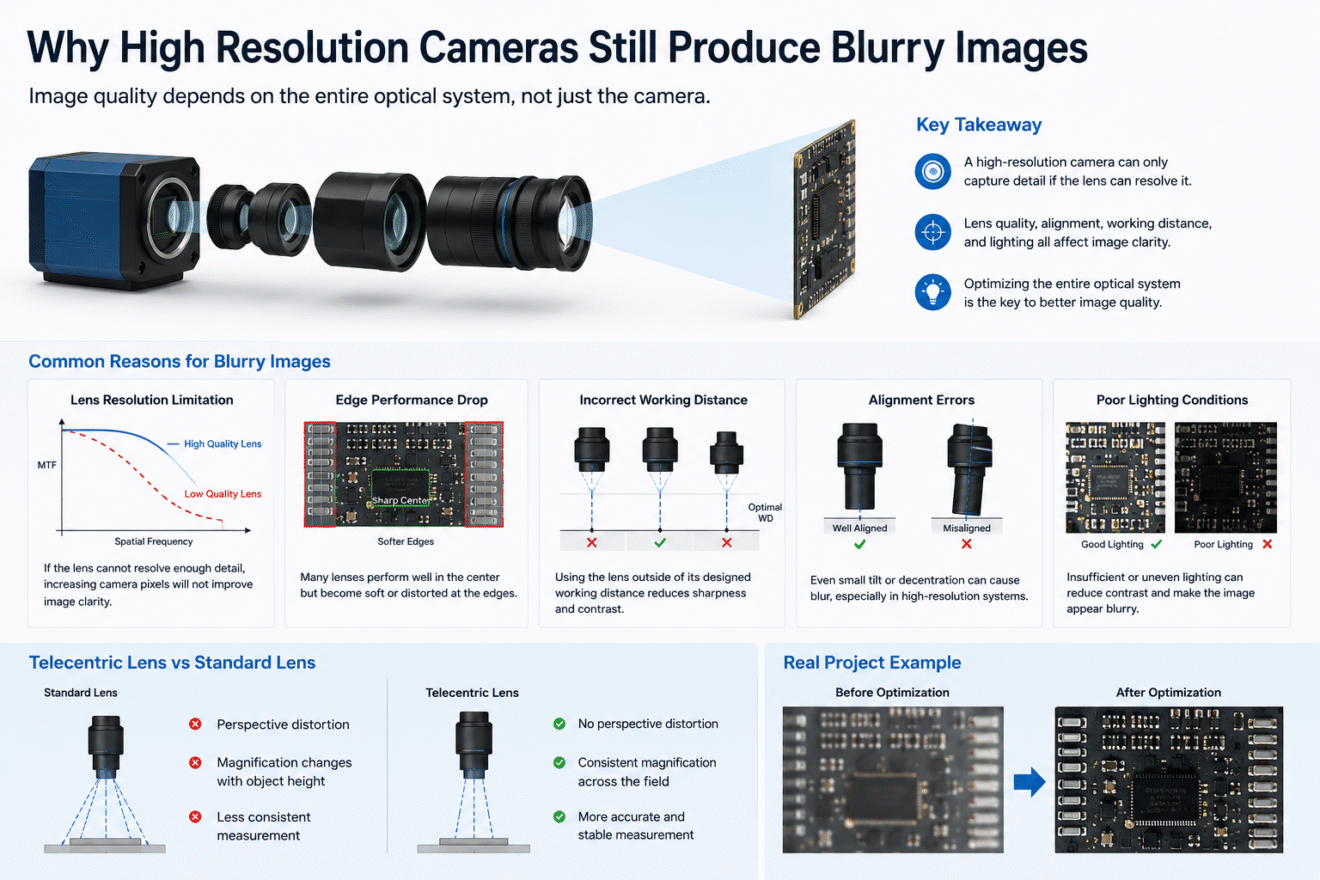
A high-resolution sensor can only capture detail if the lens is capable of resolving that detail in the first place.
Otherwise, increasing pixel count simply makes optical imperfections easier to notice.
We’ve seen projects where customers upgraded the camera resolution, but the image still looked soft because the original lens was designed for lower-resolution sensors years ago.
Sometimes the bottleneck is not the camera anymore — it’s the optics behind it.
The Lens Often Matters More Than the Camera
In industrial imaging systems, customers naturally focus on the camera first.
But in many cases, the lens has a greater influence on the final image.
Especially in high-resolution systems, lens performance becomes much more noticeable.
For example:
- edge sharpness
- contrast consistency
- distortion control
- field uniformity
all directly affect how much useful detail the camera can actually capture.
A high-resolution sensor paired with an average lens usually won’t perform as expected.
Edge Clarity Is Where Problems Usually Start
One thing we often notice during testing:
The center of the image looks fine, but the edges become noticeably softer.
This becomes more obvious as sensor resolution increases.
There are several possible reasons:
- the lens was not designed for large sensors
- image circle coverage is insufficient
- optical performance drops near the edge of the field
For inspection systems, edge quality matters more than many people realize.
Especially in applications involving measurement or defect inspection, blurry edges can directly affect consistency.
Bigger Sensors Also Make Systems More Sensitive
As sensor size and pixel density increase, the entire imaging system becomes less forgiving.
Things that were previously “acceptable” suddenly become visible:
- slight focus inconsistency
- uneven illumination
- small optical imperfections
As resolution increases, even small alignment deviations inside the optical system become easier to notice.
This is why some older optical setups struggle after upgrading to newer cameras.
The camera improves, but the rest of the system may not be ready for it.
Sometimes the Real Problem Is Lighting
Interestingly, not all blurry images are caused by the lens itself.
In some projects, the optical system was actually fine — the issue came from lighting conditions.
Poor contrast can make images appear soft even when focus is correct.
We’ve seen systems improve significantly simply by optimizing:
- illumination angle
- lighting uniformity
- surface reflections
Machine vision is rarely just about the camera or lens alone.
Telecentric Lenses Can Help in Precision Inspection
For high-accuracy inspection tasks, telecentric lenses often produce more stable results.
They help reduce:
- magnification variation
- perspective effects
- edge inconsistency
This becomes especially useful in dimensional measurement applications where consistency is more important than simply having a sharp-looking image.
Software Can Improve Images, But It Cannot Replace Optics
Today’s image processing software is extremely powerful.
But software cannot fully recover detail that was never captured clearly by the optical system.
Sharpening algorithms may improve appearance visually, but they cannot completely restore lost optical information.
In most cases, improving the optical setup first leads to more stable long-term results.
Final Thoughts
When high-resolution cameras still produce blurry images, the problem is usually not caused by one single factor.
It’s often the result of how the entire imaging system works together:
- lens performance
- sensor matching
- lighting
- optical consistency
- system setup
In many projects, improving image quality is less about chasing more pixels and more about balancing the entire optical system properly.
Need Help Optimizing Your Imaging System?
If you are working on a machine vision or industrial imaging project and struggling with image quality or inspection consistency, feel free to reach out.
We support custom optical design, precision manufacturing, lens assembly, and opto-mechanical integration for industrial imaging applications.
We’re always happy to discuss practical solutions based on real project requirements.
Founded in 2010, VY Optics started from precision optical manufacturing and gradually expanded into optical design and assembly support.
Our team mainly works on custom optical components, lens centering, optical alignment, and optical assembly for industrial and scientific applications.