Introduction
In automated optical inspection (AOI) systems, image quality directly affects inspection reliability.
But in many projects, choosing the right camera gets far more attention than choosing the right lens.
We’ve seen situations where customers upgraded sensors, lighting, and software multiple times, but the inspection results still remained unstable. In the end, the real limitation turned out to be the optical system itself.
The lens determines:
- image consistency
- edge clarity
- distortion control
- measurement stability
In AOI applications, these factors matter more than many people expect.
Here I am going to share some practical thoughts on lens selection for automated optical inspection systems based on what we’ve seen in real industrial imaging projects.
Why Lens Selection Matters So Much in AOI Systems
Unlike general imaging applications, AOI systems usually require:
- stable magnification
- repeatable measurements
- consistent image quality across the full field
Even small optical inconsistencies can affect:
- defect detection
- dimensional measurement
- edge recognition
- inspection repeatability
In many inspection systems, distortion control becomes increasingly important as measurement accuracy requirements become tighter.
This becomes even more critical in high-speed production environments.
In many cases, the difference between a stable AOI system and an unstable one comes down to the optics.
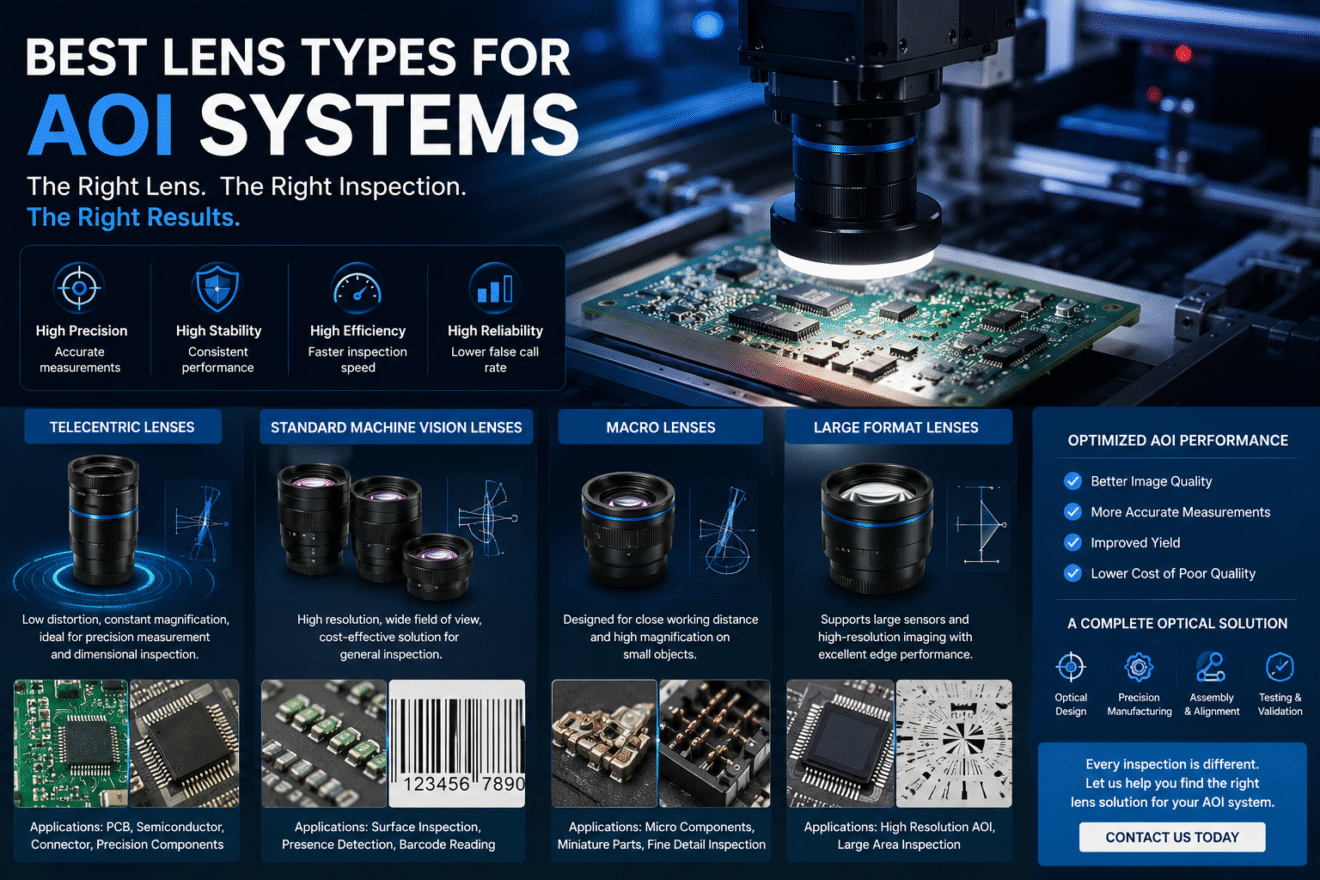
Telecentric Lenses for Precision Measurement
For many AOI applications, choosing between a telecentric lens and a standard lens directly affects measurement consistency and edge accuracy.
For dimensional inspection and high-accuracy measurement tasks, telecentric lenses are often the preferred solution.
One reason is that they help reduce perspective error.
In standard lenses, object size may appear slightly different depending on position or height variation. In AOI measurement applications, this can create inconsistent results.
Telecentric lenses help maintain:
- consistent magnification
- better edge definition
- reduced perspective distortion
This is especially useful for:
- PCB inspection
- semiconductor inspection
- connector measurement
- precision electronic components
In many precision AOI projects, telecentric optics significantly improve system consistency.
Standard Machine Vision Lenses for General Inspection
Not every AOI system requires telecentric optics.
For applications focused mainly on:
- presence detection
- surface defect inspection
- barcode reading
- positioning
standard machine vision lenses are often more practical and cost-effective.
A properly selected standard lens can still provide excellent image quality if:
- distortion is controlled
- working distance is appropriate
- sensor matching is correct
In many industrial systems, balancing performance and cost is just as important as maximizing optical precision.
Macro Lenses for Small Object Inspection
When inspecting very small objects, macro lenses are often a better choice.
These applications may include:
- micro electronic components
- precision connectors
- miniature mechanical parts
Macro lenses are designed for close working distances and higher magnification ratios.
However, depth of field becomes smaller at higher magnification, so system setup and lighting become more sensitive.
Large Format Lenses for High-Resolution Sensors
As AOI systems continue moving toward larger and higher-resolution sensors, lens compatibility becomes increasingly important.
Simply increasing camera resolution does not always improve inspection performance if the optical system itself is not optimized properly.
We’ve seen systems where the camera resolution was upgraded, but image quality actually became less stable because the lens could not fully support the larger sensor.
This often appears as:
- soft edges
- uneven sharpness
- reduced contrast near the image corners
Choosing a lens designed for the correct sensor format helps maintain consistent imaging performance.
Lighting and Lens Design Need to Work Together
One thing that often gets overlooked in AOI systems:
Good optics alone cannot solve poor lighting conditions.
In some projects, image inconsistency was caused less by the lens and more by:
- reflections
- uneven illumination
- low contrast
In practice, AOI performance depends on how well:
- optics
- lighting
- sensor
- software
work together as a complete system.
Assembly and Alignment Still Matter
Even with a good optical design, system performance can still suffer because of assembly issues.
As AOI systems become more precise, small mechanical deviations become easier to notice.
We’ve seen cases where:
- slight tilt
- decentering
- inconsistent assembly
caused image instability that looked like an optical design problem.
In high-precision inspection systems, assembly consistency is often just as important as lens selection itself.
Final Thoughts
There is no single “best” lens for every AOI system.
In practice, the right solution depends on how the lens, sensor, working distance, and inspection requirements work together.
The right solution depends on:
- inspection accuracy requirements
- object size
- sensor format
- working distance
- production speed
In many real projects, stable AOI performance comes from balancing the entire imaging system rather than focusing on a single specification.
Looking for Custom AOI Optical Solutions?
If you are developing an AOI or industrial inspection system and looking for optical support, feel free to reach out.
We support:
- custom optical design
- machine vision lens development
- precision optical assembly
- opto-mechanical integration
for industrial imaging and inspection applications.
We’re always happy to discuss practical solutions based on real project requirements.
Founded in 2010, VY Optics started from precision optical manufacturing and gradually expanded into optical design and assembly support.
Our team mainly works on custom optical components, lens centering, optical alignment, and optical assembly for industrial and scientific applications.
Our main products include microscope objectives, precision plano optics, laser focusing optics, 4F optical systems, OCT imaging optics, collimation systems, Offner spectrometer systems, Offner relay systems, and high-precision Offner relay optical assemblies.