Introduction
When customers choose a camera for a machine vision system, sensor size is often one of the first specifications they check.
A larger sensor sounds attractive because it can cover a wider field of view and collect more image information.
However, in real imaging systems, a larger sensor does not automatically mean better image quality.
The lens must be able to support the sensor properly. If the lens image circle is not large enough, or if the lens performance drops near the edge, the final image may become worse instead of better.
We have seen this in many machine vision and AOI projects. The customer upgrades the camera, but the image still has soft edges, distortion, uneven brightness, or unstable measurement results.
In many cases, the problem is not the camera itself. The lens and sensor are simply not well matched.
This article explains how sensor size affects machine vision lens performance, and what customers should check before selecting a lens.
What Does Sensor Size Mean?
Sensor size refers to the physical size of the camera sensor.
Common machine vision sensor formats include:
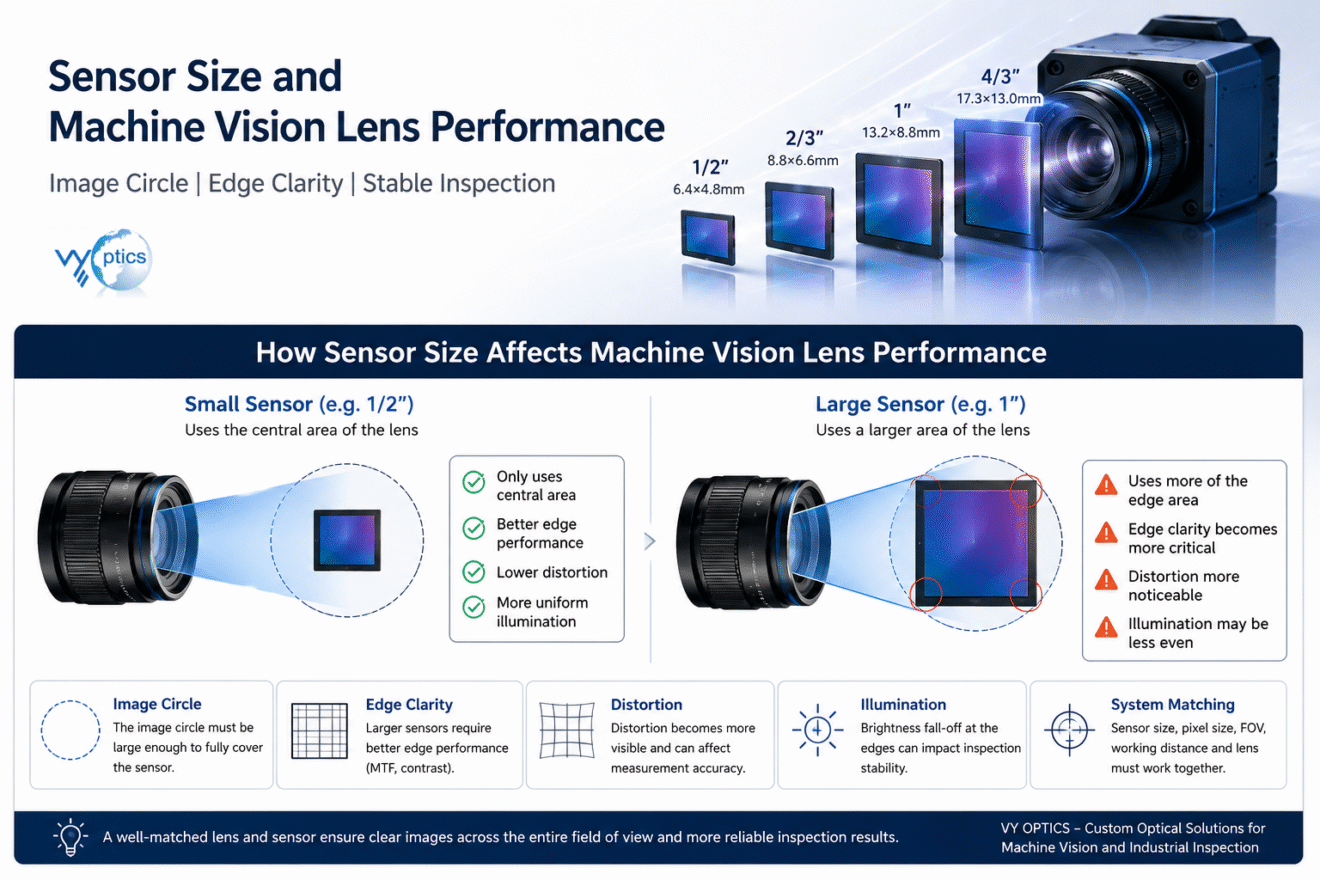
- 1/2″
- 2/3″
- 1″
- 1″
- 4/3″
- APS-C or larger formats in some special systems
A larger sensor can capture a larger image area, but it also asks more from the lens.
The lens needs to provide enough image circle to cover the whole sensor. More importantly, the image quality must remain usable from the center to the edge.
If the lens was designed for a smaller sensor, using it with a larger sensor may cause several problems:
- soft edges
- stronger distortion near the field edge
- lower contrast at the corners
- uneven illumination
- unstable measurement results
- reduced inspection reliability
For machine vision, the edge of the image is not just a visual detail. It may affect whether the system can detect defects or measure parts correctly.
Image Circle: The First Thing to Check
Every lens has an effective image circle.
The image circle must be large enough to cover the camera sensor.
If the sensor is larger than the lens can support, the corners may become dark, blurred, or unusable. Even if the image appears bright enough, the edge resolution may still be poor.
This is why customers should not only ask:
What is the focal length?
They should also ask:
What sensor size can this lens support?
For example, a lens that works well on a 2/3″ sensor may not perform well on a 1″ or 4/3″ sensor.
In AOI and precision inspection, this difference can become very obvious because defects may appear anywhere in the field of view.
Larger Sensors Make Edge Performance More Important
A small sensor mainly uses the central part of the lens image field.
Usually, the center area is easier to optimize.
A larger sensor uses more of the image field, including areas closer to the edge. Therefore, lens problems that were not obvious before may become visible after switching to a larger sensor.
Common edge-related problems include:
- field curvature
- astigmatism
- distortion
- lower MTF
- reduced contrast
- uneven illumination
This is one reason why a system may look good with a smaller camera, but become less stable after a camera upgrade.
The camera did not create the problem. It simply made the lens limitation easier to see.
Sensor Size and Field of View
Sensor size directly affects field of view.
With the same lens and working distance, a larger sensor usually captures a wider field of view.
This can be useful when the system needs to inspect a larger object area at one time.
However, a wider field also means the lens must maintain good performance over a larger image area.
For example, in PCB inspection, connector inspection, display panel inspection, or precision part inspection, the system may need to check details across the whole field. If the center is clear but the edges are soft, the inspection result may not be reliable.
This is why field of view and lens performance should always be considered together.
A larger field of view is useful only when the lens can keep the image quality stable across that field.
Sensor Size and Pixel Size
Sensor size is only one part of the camera specification. Pixel size also matters.
Some large sensors have small pixels. This means the camera can capture more detail, but only if the lens can provide enough optical resolution.
If the lens resolution is not high enough, the extra pixels will not create more useful information.
In simple terms, the camera may have more pixels, but the lens cannot feed those pixels with enough detail.
This is common when customers upgrade from a lower-resolution camera to a higher-resolution camera without changing the lens.
The image file becomes larger, but the real inspection performance does not improve much.
For small-feature inspection, this becomes even more important.
In some customized AOI and flat-field imaging projects, the system may need to observe features around 12 μm. At this level, the lens, sensor pixel size, working distance, lighting, and assembly accuracy all need to match the real inspection target.
Camera resolution alone cannot solve the problem.
Distortion Becomes More Noticeable on Larger Sensors
When a system uses a larger sensor, distortion near the edge may become more visible.
For ordinary imaging, a small amount of distortion may not matter much. But in machine vision, especially measurement applications, distortion can affect the final result.
If the system needs to measure size, position, hole diameter, spacing, or edge distance, lens distortion must be controlled carefully.
Software calibration can help, but it should not become the only solution. If the optical distortion is too large or unstable, software correction may not fully solve the problem.
For this reason, low-distortion lens design becomes more important when using larger sensors or wider fields of view.
Field Curvature and Edge Softness
Field curvature is another common issue.
The camera sensor is flat, but the best focus surface of a lens may not be perfectly flat. As a result, the center of the image may be sharp, while the edges are slightly out of focus.
This problem is especially important for AOI and flat-object inspection.
For example, when inspecting PCB boards, wafers, display panels, or other flat parts, the object itself may be flat. If the lens cannot provide a flat image field, the system may still show soft edges.
A flat-field machine vision lens is designed to reduce this problem.
For applications that require consistent image quality across the full sensor, flat-field performance is often more important than only having a high center resolution.
Why Lens Matching Matters in AOI Systems
AOI systems often need stable image quality across the whole inspection area.
A mismatch between sensor and lens can lead to:
- missed defects near the edge
- inconsistent defect recognition
- measurement differences between center and edge
- repeated software compensation
- longer debugging time
- lower inspection confidence in production
This is why lens selection should start from the whole system requirement.
The key questions are:
- What sensor size will be used?
- What is the required field of view?
- What is the smallest feature or defect?
- Does the system need measurement or only defect detection?
- What working distance is available?
- Is the object flat or three-dimensional?
- Does the lens need low distortion?
- Does the system need stable performance across the full field?
When these points are clear, the lens direction becomes much easier to define.
Common Mistake: Choosing the Camera First
Many projects start with the camera.
The customer selects a high-resolution camera first, and then looks for a lens to match it.
This is understandable, but it can create problems.
If the sensor is large, the pixel size is small, or the field of view is wide, the lens requirement may become much more demanding than expected.
In some cases, a standard lens cannot fully support the camera. Then the system may need a custom optical design or a different camera-lens combination.
A better approach is to evaluate the camera and lens together from the beginning.
This can save time during later debugging and reduce the risk of image-quality problems after installation.
When Custom Lens Design Is Needed
Standard machine vision lenses can solve many common tasks.
However, custom lens design may be necessary when the application has special requirements, such as:
- large sensor format
- wide field of view
- small defect size
- strict edge clarity
- low distortion requirement
- special working distance
- customized wavelength
- limited mechanical space
- need for stable performance in batch production
For these projects, the lens is not just a catalogue item.
It becomes part of the whole optical system。
At VY Optics, we support custom optical lens design, optical component manufacturing, precision lens assembly, alignment, and opto-mechanical integration.
This is especially useful when customers need a lens that matches a specific sensor, field of view, working distance, and inspection target.
VY Optics Support for Machine Vision Lens Projects
VY Optics provides customized optical solutions for machine vision, AOI, industrial inspection, scientific imaging, and precision imaging systems.
Depending on the project, we can support:
- custom machine vision lens design
- flat-field imaging lens design
- low-distortion lens design
- optical component manufacturing
- precision lens assembly and alignment
- customized wavelength coatings
- mechanical structure design
- opto-mechanical integration
Some customers only need a lens group or optical components. Others need a complete lens module that can be installed into their equipment.
In both cases, we usually start from the real application instead of only looking at one parameter.
Sensor size is important, but it should be considered together with the full optical requirement.
Practical Checklist Before Choosing a Lens
Before choosing a machine vision lens, we suggest confirming these points:
- camera sensor size
- pixel size
- required field of view
- working distance
- wavelength range
- smallest defect or feature size
- acceptable distortion
- required depth of field
- available installation space
- object height variation
- lighting method
- inspection speed
- measurement accuracy requirement
With this information, it becomes easier to decide whether a standard lens is enough or whether a custom lens is more suitable.
The goal is not simply to use a larger sensor or a higher-resolution camera.
The goal is to build a stable imaging system.
Final Thoughts
Sensor size has a direct impact on machine vision lens performance.
A larger sensor can provide a wider field of view and more image information, but it also places higher requirements on the lens.
If the lens cannot support the sensor properly, the system may suffer from soft edges, distortion, uneven illumination, or unstable inspection results.
For AOI and precision inspection, the best solution is not always the largest sensor or the highest-resolution camera.
The better solution is a well-matched camera-lens system.
When the lens, sensor, working distance, lighting, and mechanical structure work together, the final inspection result becomes much more reliable.
Need Help Matching a Lens to Your Sensor?
If you are selecting a lens for a machine vision system, AOI equipment, or precision inspection platform, VY Optics can help evaluate the optical requirements.
Please send us your sensor size, pixel size, field of view, working distance, wavelength, smallest feature size, and inspection target.
We can help discuss whether a standard lens, flat-field lens, low-distortion lens, or custom optical design is more suitable for your project.