Introduction
When customers select a lens for an automated optical inspection system, they often compare two options: a flat-field lens and a telecentric lens.
At first, the choice may seem simple. However, these two terms describe different optical characteristics rather than two completely opposite lens types.
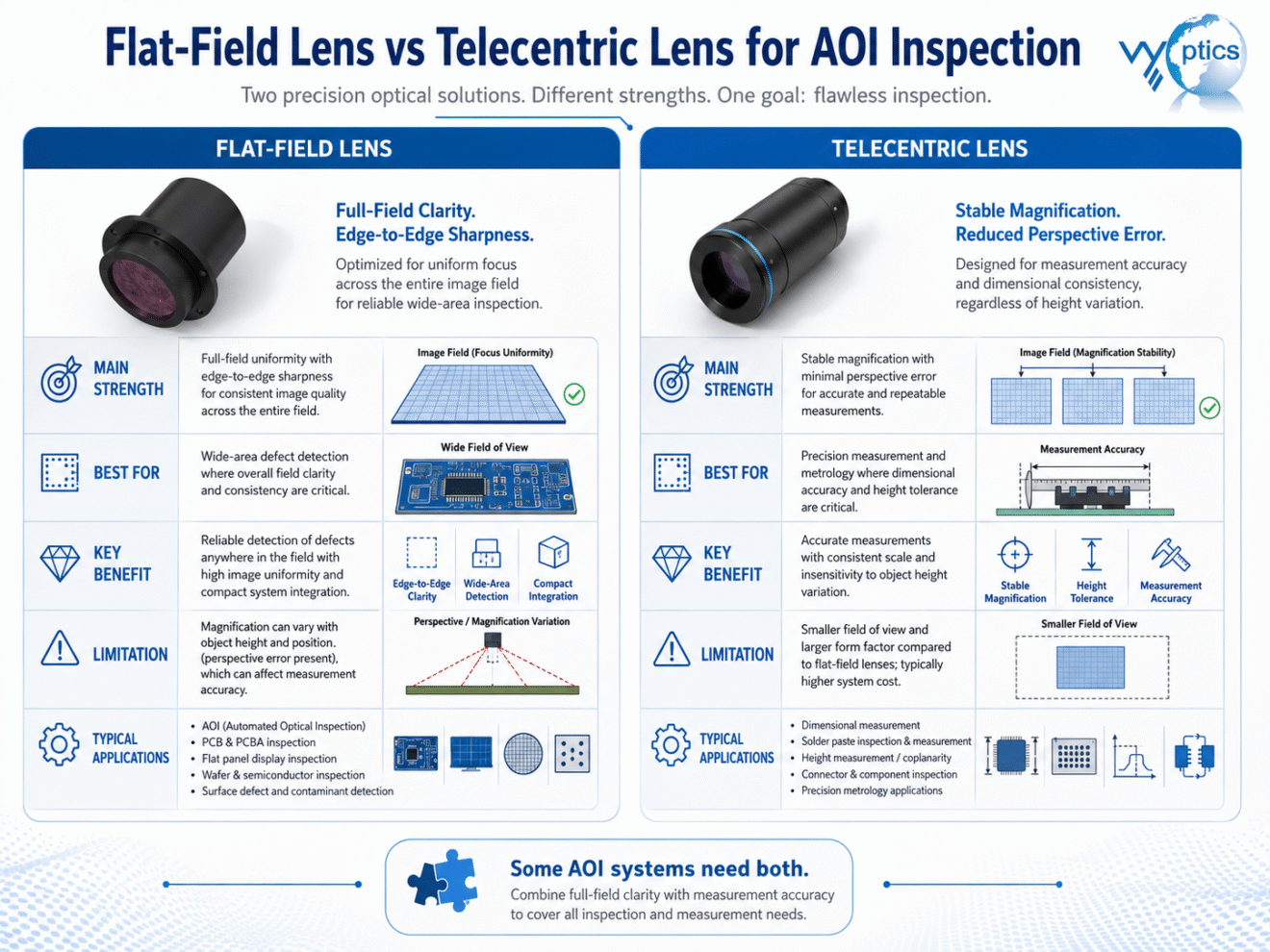
Optical designers use a flat-field design to improve image consistency from the center to the edge of the field. By contrast, a telecentric design helps maintain a more stable magnification when the object position or height changes.
Therefore, a lens can offer flat-field performance, telecentric performance, or both.
The right choice depends on what the AOI system actually needs to do. For example, some systems mainly detect surface defects, while others measure dimensions or locate edges. In more demanding applications, the system may need to do both.
Before selecting the lens, it is useful to ask a more practical question:
Does the system need better full-field clarity, more stable measurement, or both?
This article explains the difference and shows when each lens type works better.
What Is a Flat-Field Lens?
A flat-field lens helps reduce field curvature and maintain more consistent focus across the image.
In a general imaging lens, the best-focus surface may curve instead of matching the flat camera sensor. As a result, the image center can look sharp while the edges appear softer.
For ordinary observation, this may not cause a serious problem. In AOI, however, it can directly affect inspection reliability.
Small scratches, particles, broken edges, coating defects, and tiny structural features may appear anywhere in the field of view. If the lens only performs well in the center, the system may struggle to recognize defects near the edge.
A flat-field machine vision lens can improve:
- center-to-edge image consistency
- edge clarity
- full-field defect detection
- image quality on larger sensors
- inspection stability during repeated production
In one type of flat-field imaging project, our system needed to observe features around 12 μm under the specified camera, lighting, working distance, and optical configuration.
At that scale, sharp center imaging alone was not enough. The system also needed to keep the small features visible across the inspection area.
That requirement shows the practical value of flat-field performance.
What Is a Telecentric Lens?
A telecentric lens controls the chief-ray direction so that the rays remain nearly parallel to the optical axis within the designed range.
In most machine vision measurement projects, customers refer to an object-space telecentric lens.
Its main advantage comes from magnification stability. When the object moves slightly toward or away from the lens, its apparent size changes much less than it would with a conventional lens.
This feature helps reduce perspective-related measurement errors.
Engineers often choose telecentric lenses for:
- dimensional measurement
- edge-position inspection
- hole-diameter measurement
- part alignment
- profile inspection
- components with height variation
- applications requiring stable magnification
For example, a conventional lens may show a closer part as slightly larger. A telecentric lens reduces this effect and helps the system produce more repeatable measurements.
However, telecentricity does not automatically guarantee sharp edges, low distortion, or full-field consistency.
Designers still need to control resolution, field curvature, distortion, sensor coverage, and assembly accuracy.
The Main Difference: Full-Field Clarity or Measurement Stability?
The easiest way to understand the difference is to look at the main problem each design solves.
A flat-field lens mainly answers this question:
Can the image remain clear and usable from the center to the edge?
A telecentric lens mainly answers another question:
Can the system maintain stable magnification when the object position or height changes?
For surface-defect detection, full-field image consistency may matter more.
For dimensional measurement, magnification stability and reduced perspective error usually become more important.
Meanwhile, some AOI systems need both capabilities. This often happens when the equipment must detect small defects and measure the part at the same time.
In that case, a telecentric lens with good flat-field performance may offer the better solution.
When Does a Flat-Field Lens Work Better for AOI?
A flat-field lens often works well when the main task involves defect detection across a relatively large field of view.
Typical applications include:
- PCB surface inspection
- display-panel inspection
- wafer-surface inspection
- connector appearance inspection
- electronic-component inspection
- scratch and particle detection
- precision-part surface inspection
In these applications, defects may appear anywhere in the image. Therefore, the system needs stable clarity across the whole inspection area rather than excellent performance in the center alone.
A flat-field lens may suit the project when:
- the inspected surface is relatively flat
- object-height variation remains small
- the system mainly detects defects
- the full field needs consistent clarity
- the machine has limited installation space
- the system uses a relatively large sensor
- the customer prefers a compact optical structure
Depending on the field of view and working distance, a flat-field machine vision lens may also use less space than a telecentric system.
For customers who need reliable defect detection but do not require strict telecentric measurement, this option can offer a practical balance between performance, size, and cost.
When Does a Telecentric Lens Work Better for AOI?
A telecentric lens usually works better when the AOI system must perform accurate dimensional measurement.
It becomes especially useful when:
- object height changes during inspection
- the system measures width, diameter, spacing, or edge position
- perspective error affects the final result
- parts do not stay at exactly the same height
- the customer requires repeatable measurements
- the inspection target contains three-dimensional features
For example, an AOI system may need to measure the diameter of a circular hole. If the part position changes slightly, a conventional lens can introduce apparent size changes.
A telecentric lens helps maintain a more stable image scale and improves measurement repeatability.
Still, telecentric lenses are not automatically better for every project. They often require more installation space, larger front elements, controlled illumination, and a higher budget.
Therefore, the measurement requirement should drive the decision, not the lens name.
Can One Lens Be Both Flat-Field and Telecentric?
Yes.
Flat-field performance and telecentricity describe different optical properties, so they do not exclude each other.
A telecentric lens can also offer:
- low field curvature
- strong center-to-edge resolution
- low distortion
- large-sensor coverage
- consistent image quality
This combination is useful in high-accuracy AOI systems.
For example, a system may need to:
- detect small defects across the full field
- measure dimensions accurately
- maintain stable magnification
- support a large-format sensor
- reduce edge softness
- improve inspection repeatability
In this situation, designers may combine telecentricity with flat-field optimization.
However, this combination makes the optical design more demanding. It also places tighter requirements on manufacturing, lens centration, mechanical tolerances, assembly, and testing.
As a result, a custom lens may work better when a standard product cannot meet all the requirements.
Flat-Field Lens vs Telecentric Lens: A Practical Comparison
Choose a flat-field lens when:
- surface-defect detection is the main task
- the object surface is relatively flat
- full-field clarity matters
- object-height variation is limited
- the system needs a compact structure
- strict telecentric measurement is unnecessary
Choose a telecentric lens when:
- dimensional measurement is the main task
- magnification stability is critical
- the object has height variation
- perspective error affects the result
- accurate edge positioning is required
- the system can accept a larger optical structure
Consider a flat-field telecentric design when:
- the system needs defect detection and measurement
- small features must remain clear across the full field
- the camera uses a large or high-resolution sensor
- measurement results must stay consistent across different image areas
- a standard lens cannot meet the project requirements
Resolution Is Not the Only Specification
Many customers start by checking camera megapixels or lens resolution.
Although resolution matters, it does not determine the final inspection result by itself.
The complete imaging system also depends on:
- sensor size
- pixel size
- field of view
- working distance
- numerical aperture
- depth of field
- distortion
- field curvature
- illumination
- mechanical stability
- lens assembly and alignment
When the target feature measures around 12 μm, these factors become even more important.
For instance, a lens may resolve the feature clearly in the center but lose detail near the edge. Likewise, a system may work well in the laboratory but become less stable after installation on a production line.
Because of this, we usually start with the real inspection requirement instead of choosing a lens only from a catalogue specification.
Questions to Ask Before Selecting the Lens
Before deciding between a flat-field lens and a telecentric lens, confirm the following information:
- What sensor size will the camera use?
- What field of view does the system require?
- What is the available working distance?
- What is the smallest defect or feature?
- Does the system perform defect detection, measurement, or both?
- How much object-height variation will occur?
- What measurement accuracy does the project require?
- How much distortion can the system accept?
- Does the image need to remain clear across the full field?
- Which illumination method will the system use?
- How much installation space is available?
These questions usually provide more value than simply asking which lens type is better.
Ultimately, the best lens is the one that matches the actual inspection task.
Custom AOI Lens Solutions from VY Optics
VY Optics provides custom optical solutions for AOI, machine vision, industrial inspection, and precision imaging applications.
Depending on the project, we can support:
- flat-field machine vision lens design
- telecentric lens design
- low-distortion imaging lenses
- optical component manufacturing
- precision lens assembly and alignment
- customized wavelength coatings
- mechanical structure design
- opto-mechanical integration
Some customers only need an optical design or a lens group. Others need a complete lens module that can integrate directly into their equipment.
In both cases, the final performance depends on more than the optical prescription. Manufacturing accuracy, lens centration, mechanical tolerances, assembly, and system adjustment must work together.
For this reason, we do not start by recommending a flat-field lens or a telecentric lens immediately. Instead, we first review the camera, field of view, working distance, object characteristics, smallest feature size, and measurement requirements.
Then we can choose a more practical optical direction.
Frequently Asked Questions
Is a telecentric lens always better for AOI?
No. A telecentric lens works well when magnification stability and measurement accuracy matter. However, for surface-defect detection on a relatively flat object, a flat-field machine vision lens may provide a more compact and practical solution.
Can a flat-field lens support measurement?
Yes, especially when the lens also provides low and stable distortion. However, if the object height changes or the system requires strict dimensional accuracy, a telecentric lens may produce more repeatable results.
Is a telecentric lens automatically flat-field?
No. Telecentricity describes ray geometry and magnification behavior. Field flatness, resolution, and distortion remain separate performance requirements.
Can VY Optics customize both lens types?
Yes. VY Optics supports custom flat-field machine vision lenses, telecentric lenses, optical manufacturing, precision assembly, alignment, and opto-mechanical integration.
What information do you need for a quotation?
Please provide the sensor size, pixel size, field of view, working distance, wavelength, smallest feature size, measurement accuracy, object-height variation, mount, and installation-space limits.
Final Thoughts
No single lens works best for every AOI system.
If soft edges and inconsistent full-field image quality create the main problem, a flat-field lens may offer the better solution.
If object-height variation causes measurement errors, a telecentric lens may work better.
When the system requires both full-field clarity and stable measurement, a custom flat-field telecentric design may be worth considering.
Therefore, the final decision should come from the actual inspection target rather than the product name.
Need Help Choosing an AOI Lens?
If you are developing an AOI system or upgrading an existing machine vision platform, VY Optics can help evaluate whether a flat-field lens, telecentric lens, or custom optical design fits the application better.
Please send us your camera sensor, field of view, working distance, wavelength, smallest feature size, measurement requirement, and installation conditions.
We will review the requirements and discuss a practical optical solution for your project.